How to Calculate the Size of Your Home Solar System
A solar panel system for your home might seem complicated, but it’s actually quite logical. Think of it like a car: you need an engine (the inverter), a fuel tank (the batteries), and a fuel producer (the solar panels).
The main thing is to know two key pieces of information:
- How much energy do you need at one time? (Peak Consumption)
- How much energy do you use in total per month? (Monthly Consumption)
With these two numbers, we can figure out how many panels, how powerful an inverter, and how big a battery bank you’ll need.
The Inverter – Your Home's "Brainpower"
What is it?
The inverter converts the energy from your solar panels into a form that your home appliances can use. It’s like the brain that distributes electricity.
How to calculate it?
We need to know the maximum amount of electricity your home uses at any single moment. Imagine all your most powerful appliances running at the same time:
- Washing machine (2 kW)
- Oven (2.5 kW)
- Well pump (1 kW)
Adding these three together, your peak consumption is 2 + 2.5 + 1 = 5.5 kW.
Your inverter needs to be a bit more powerful than this peak consumption. Why? Because in addition to your big appliances, you have many small ones you might not even notice: lights, Wi-Fi router, refrigerator, circulation pumps, etc. All of these need electricity too.
So, if your maximum peak consumption is 5.5 kW, the inverter’s power should be at least 6 kW.
How can you find out your peak consumption?
- Check your main fuse: This is the easiest way! The main fuse’s capacity is given in amperes (A). To convert this to kilowatts (kW), multiply it by 230 (volts) and divide by 1000 (to get kilowatts).
- For example: If your main fuse is 20 amperes, it allows a maximum consumption of: 20A×230V=4600W=4.6kW.
- Good rule of thumb: If you’ve lived in a house with a 20 A main fuse for a long time and it has never tripped, then a 5 kW inverter will likely be enough for you.
- For a new home or if your fuse is small: If you’re planning a new home or your current fuse is small and you’re unsure, make a list of your electrical appliances and their power ratings.
- Example:
- Washing machine: 2 kW
- Electric stove: 1.5 kW
- Hair dryer: 1 kW
- Kettle: 0.8 kW
- Microwave: 0.7 kW
- Add up the ones that might be running at the same time. This will give you a good idea of the inverter power you need.
- Example:
The Battery Bank – Your Energy Reserve
What is it? A battery bank is like a large battery that stores electricity produced by your solar panels so you can use it even when the sun isn’t shining (for example, at night or on cloudy days).
How to calculate it?
The easiest way is to look at your old electricity bills. They’ll show you how many kilowatt-hours (kWh) you use on average per month.
Rule of thumb: Your battery bank should be large enough to cover three days of electricity consumption. This provides a good buffer for bad weather.
Example: If your monthly electricity consumption is 300 kWh.
- Your daily consumption is then 300kWh/30days=10kWh.
- For a three-day reserve, you’ll need a battery bank with a capacity of 10kWh/day×3days=30 kWh.
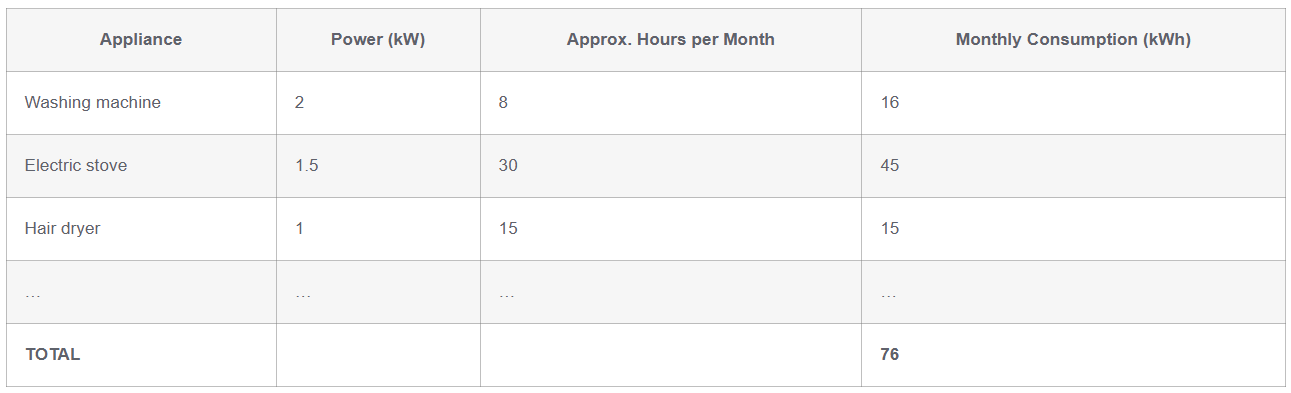
If you’re planning a completely new home, your previous main fuse might not give an accurate picture of the new home’s energy consumption. In that case, you should create a table of consumption, listing each appliance’s power separately and its approximate monthly usage hours, then add up the total consumption. For example:
Solar Panels – Your Energy "Factory"
What are they? Solar panels convert sunlight into electricity. The more panels you have, the more electricity you’ll produce.
How to calculate it?
We’ll calculate the number of panels based on the size of your battery bank, because the main job of the panels is to charge the batteries and supply power to your home.
We assume the panels are installed facing South and at the correct tilt (this helps them produce the most energy). We also factor in that in Estonia, a sunny day provides about 8 hours when the panels produce well.
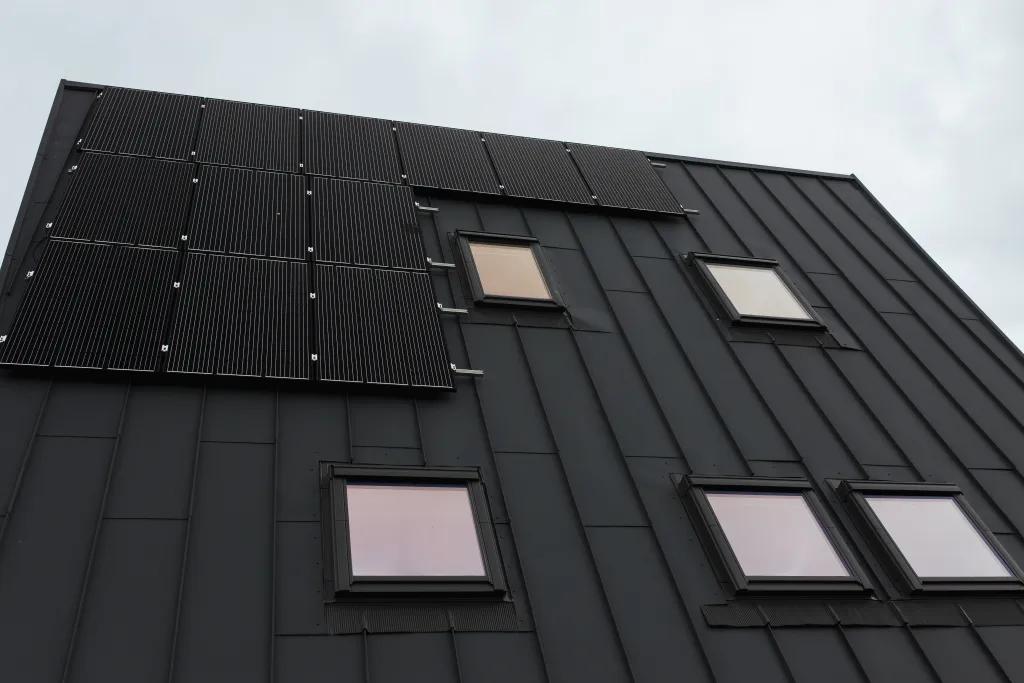
Example: If you need to charge a 30 kWh battery bank (and also supply electricity to your home).
- Let’s assume solar panels produce about 80% of their rated power (due to small losses).
- To charge the battery bank from 0% to 100% and cover home consumption, you need to get energy from the sun every hour: 30kWh/8hours=3.75kW per hour.
- Considering also about 20% losses (for example, in cables or the inverter, or if the panel angle is different from optimal), you’ll need a total panel power of: 3.75kW×1.20(loss calculation)≈4.5 kW.
This means you would need panels with a total power output of about 4.5 kW. If one panel’s power is, for example, 400 W (or 0.4 kW), then you would need about 4.5kW/0.4kW/panel≈11−12 panels. Of course, it’s wise to plan for a slight surplus of panels, but this surplus shouldn’t be too large unless you intend to sell excess power back to the grid.
It’s also important to remember that for about few months a year ( in Estonia it is November-February), there simply isn’t enough sunlight, and you’ll need to use grid electricity or a generator to charge your battery bank.
In summary:
- Inverter: Think about how many of your most powerful appliances are running at once, and add a little extra. Or check your main fuse capacity.
- Battery Bank: Look at your average monthly consumption from your electricity bills and divide it by ten to get a three-day reserve.
- Solar Panels: Calculate how much energy you need daily to fill your battery bank and power your home, then divide that by the number of daily sun hours.